
Matriarch Deborah Massiah (-1693) and Amelia Reed
Our heritage begins with the enslaved Children of Israel, through our grandmother Amelia, from whom the Massiah family of Imran descends. Debora, matriarch of the Massiah family of Barbados and a central ancestor within our lineage, was Amelia’s grandmother. While Deborah was the mother of Jacob Massiah’s children, Jacob is not the grandfather of Amelia or of the Massiah family of Imran.
Our Grandfathers – The Enslaved Africans Children of Israel
Our grandfathers and their children (likely males) would have been separated from our grandmothers, whose lives were shaped by coercion and loss, yet who endured. Not much is known about our grandfathers, who were more than likely displaced across the Atlantic and, in many cases, martyred, as referenced in history, including accounts of enslaved “Africans” and other captives being thrown overboard during the transatlantic slave trade. Despite these conditions, our grandmothers carried forward lineage, memory, and strength, even as the Huns, who are said to have descended from Attila, imposed control and sought to redefine their place within history.
“And [recall] when We saved you from the people of Pharaoh, who were afflicting you with the worst torment—slaughtering your sons and keeping your women alive…” — Al-Baqarah (The Cow) — 2:49
“And [remember] when We saved you from the people of Pharaoh, who afflicted you with the worst torment—killing your sons and keeping your women alive…” — Al-A‘raf (The Heights) — 7:141
“…They were afflicting you with the worst torment, slaughtering your sons and keeping your women alive…” — Ibrahim (Abraham) — 14:6
“Indeed, Pharaoh exalted himself in the land and made its people into factions, oppressing a group among them, slaughtering their sons and keeping their women alive…” — Al-Qasas (The Stories) — 28:4
“And I will surely mislead them, and I will arouse in them desires, and I will command them so they will slit the ears of cattle, and I will command them so they will alter the creation of Allah.” — An-Nisa (The Women) — 4:119
The Captive: William McCaskey, 41, Scotland
Our grandfather, William McCaskey, was captive to Amelia, and in this complex history of enslavement and survival, became part of the unfolding story of our lineage. As much as we acknowledge and understand the immense struggles endured by our grandmothers, we are grateful to be here today, carrying forward their memory, resilience, and strength.
Qur’anic Reflection on Endurance
The Qur’an reminds us of the enduring value of perseverance and trust in Allah even through hardship:
“Indeed, Pharaoh exalted himself in the land and made its people into factions, oppressing a group among them, slaughtering their sons and keeping their women alive…” — Al-Qasas (The Stories) — 28:4
This verse reflects the trials faced by our ancestors and honours their patience, fortitude, and the blessings passed down through their legacy.
Names and Identity
We recognise that the names Amelia and Debora may not have been our grandmothers’ original names. Through enslavement, names were often taken, altered, or replaced, and with them, parts of identity and memory were obscured. Among Jewish people, names were sometimes changed for assimilation or to avoid discrimination, particularly in trade and daily survival.
It is recognised that the Huns converted to Judaism, and that this formed part of a wider design in which our grandmothers were written out of history and their true identities concealed.
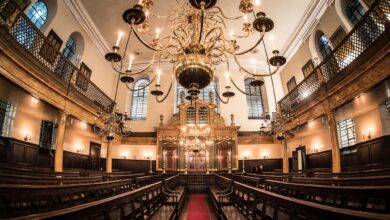
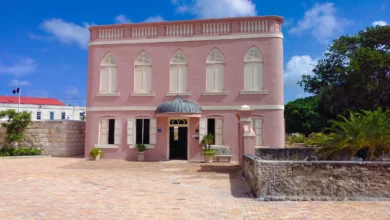
Nidhe Israel Heritage 🕋
Revelation, Lineage, and Discovery 👁️
The matriarch shared with her aunt a calling she had experienced to the Prophet Abraham through prayer, a moment that stirred remembrance and connection to lineage. Through this, the link to Nidhe Israel came to light within the Massiah family of Imran, carried through our aunt, who revealed that our grandfather, William McCaskey of Scotland, had told his children that their family held ownership of the Nidhe Israel Synagogue. William (a Hun) is also said to have known that our grandmother descended from the lineage of the Prophets Isaac and Jacob (peace be upon them).
The Nidhe Israel Synagogue, regarded as the first synagogue in the Western Hemisphere, is understood within our narrative to have been established through this lineage and the covenant connected to Jacob—a covenant rooted in divine promise. However, the lineage of Ishmael is preserved despite hardship, concealment, and displacement:
• Hardship: survival in the desert beginnings
• Displacement: separation from Abraham’s central household
• Concealment: reduced visibility in early scriptures, later reasserted
The synagogue stands today as a reminder that the legacy of our grandmothers—the enslaved Children of Israel and descendants of the Prophet Abraham (peace be upon him)—has endured and continues through generations. It is held that they carried within them knowledge, memory, and sacred trust connected to the Covenant. It is further believed that aspects of their spiritual inheritance may be reflected within the Nidhe Israel Torah, which contains the five books of Moses.
Within the Qur’an, the reality of deception and misguidance is made clear:
“And [Satan] said, ‘My Lord, reprieve me until the Day they are resurrected.’
[Allah] said, ‘So indeed, you are of those reprieved.’
[Satan] said, ‘Because You have put me in error, I will surely sit in wait for them on Your straight path. Then I will come to them from before them and from behind them and on their right and on their left, and You will not find most of them grateful.’” — Al-A‘raf (The Heights) — 7:14–17
This passage speaks to trials, distortion, and the struggle over truth across generations. Within this understanding, the endurance of lineage and covenant remains significant, even where histories have been obscured or altered.
It is further held that our grandparents were taken from the British Isles, namely the United Kingdom, as we are descendants of King James I, linking our story across lands, histories, and generations.
On 5 November 2024, the matriarch turned deeply to her family history and came to recognise the Massiah family of Barbados, our relationship to the Palestinians, and the genocide. She later revealed the complete lineage from Abraham to Muhammad (SAW), and the gathering of the scattered Children of Israel (Prophet Jacob AS, not the State of Israel), together with the Ummah, in preparation for the Return. It was also discovered that Prophet Muhammad (SAW) has yet to appear, and that he is not only the Seal of the Prophets but also a descendant of Isa, the Messiah.
Legacy, Covenant, and Remembrance 🌿
As a people shaped by hardship, remembrance remains essential. In the Qur’an, it is said:
“Indeed, Allah commands justice, excellence, and giving to relatives, and forbids immorality, wrongdoing, and oppression.” — An-Nahl (The Bee) — 16:90
This reminds us that oppression is neither forgotten nor without account, and that dignity, truth, and justice remain part of the inheritance carried forward.
The Qur’an also calls for the preservation of truth and trust across generations:
“O you who believe, stand firmly for justice, as witnesses to Allah, even if it be against yourselves or parents and relatives.” — An-Nisa (The Women) — 4:135
And it affirms that no history, however hidden, is beyond the knowledge of Allah:
“And not absent from your Lord is any [part] of an atom’s weight within the earth or within the heaven, or [anything] smaller than that or greater, but that it is in a clear record.” — Yunus (Jonah) — 10:61
Remembrance is not only an act of reflection, but of restoration—holding firmly to lineage, truth, and covenant, even where these have been obscured, trusting that what has been carried through struggle remains known, preserved, and accounted for.
Nidhe Israel Synagogue – The Diaspora & Scattering 🌍
Dispersion & Testing – Qur’anic Foundation
The Qur’an establishes a theological structure concerning the Children of Israel.
Covenant
“O Children of Israel, remember My favour which I have bestowed upon you and fulfil My covenant…” — Al-Baqarah (The Cow) — 2:40
Divine favour is linked to responsibility, requiring the fulfilment of the covenant and obedience to Allah.
Dispersion
“And We divided them throughout the earth into nations…” — Al-A‘raf (The Heights) — 7:168
Dispersion is described as:
-
A divine decree
-
A moral differentiation (some righteous, others otherwise)
-
A test designed for return
Cycles of Corruption & Return
“You will surely cause corruption on the earth twice… Then We gave back to you a return victory over them… If you do good, you do good for yourselves…” — Al-Isra (The Night Journey) — 17:4–8
Pattern introduced: Corruption → Consequence → Return → Accountability
This passage becomes the hinge between Scattering and Future Gathering.
Universal Testing
“And We will surely test you with something of fear and hunger…” — Al-Baqarah (The Cow) — 2:155
Testing is universal—not exclusive.
Spiritual Purpose
“Be persistently standing firm for Allah, witnesses in justice…” — Al-Ma’idah (The Table Spread) — 5:8
“O mankind… the most noble of you in the sight of Allah is the most righteous…” — Al-Hujurat (The Chambers) — 49:13
Diaspora in the Qur’an is not racial destiny. It is spiritual testing.
Indigenous Peoples of the Caribbean – Arawak and Taíno 🏝️
Before European colonisation, the Caribbean islands were inhabited by the Arawak and Taíno peoples.
Arawak peoples settled in the Caribbean as early as c. 2000 BCE, migrating from the Orinoco River region in South America.
Taíno peoples, a subgroup of the Arawak, were established in islands including Barbados, Jamaica, Hispaniola, Puerto Rico, and Cuba by the first millennium CE.
These communities:
-
Developed agriculture, fishing, and trade networks
-
Established complex social and spiritual systems
-
Were the first inhabitants encountered by Europeans during the late 15th century, prior to the arrival of settlers and our European diaspora
Timeline of Caribbean Context
| Period | Event |
|---|---|
| c. 2000 BCE | Early Arawak migrations from South America into Caribbean islands |
| c. 500–1000 CE | Taíno peoples established in Greater Antilles and Barbados |
| 1492 CE | European arrival begins, encounters with Taíno and Arawak communities |
| 17th century | Arrival of European settlers, including members of the Massiah family diaspora |
The Arawak and Taíno peoples’ presence provides historical context to the lands into which our family lineage arrived, linking European origins and Abrahamic ancestry to the region without reference to West Africa.
-
The Indigenous Europeans would have been Black prior to the invasion and captivity associated with the Huns.
-
Our grandmothers would have been reproducing during the period from 500 CE to 1500 CE, a long period of obscurity during which histories, identities, and lineages became increasingly concealed or redefined.
-
The Huns entered Europe around c. 370 CE and were active mainly during the 4th–5th centuries CE. Their empire collapsed shortly after 453–469 CE, following the death of Attila, after which they assimilated and ceased to play a significant role in European history. The period from approximately 500 CE onwards is commonly referred to as the Early Middle Ages, followed by the Medieval period. This era is often characterised by political fragmentation, limited written records in some regions, and large-scale migrations and cultural transitions.
We are distinct from those today classified as “Native Americans,” a population that, according to the Qur’an and historical accounts, did not exist until after the arrival of Bleda and Attila in 434 CE. Many current inhabitants of our ancestors’ lands remain unaware that they have been reclassified as the indigenous people and direct descendants of Abraham. A majority of people today do not carry the same DNA as the original man, Adam, and the Prophets, due to invasion and reproduction with the Huns. As a result, many are unaware of their true origins, or that mankind today is mixed with another creation. The Qur’an reminds us of the distinct creations:
“And We did certainly create man out of clay from an altered black mud.” — Al-Hijr (The Rocky Tract) — 15:26
“And the jinn We created before from scorching fire.” — Al-Hijr (The Rocky Tract) — 15:27
Sephardic Presence in Barbados & Diaspora Network 🕍
The Sephardic Captives of Barbados ⛓️
In 1654, the Huns, who claimed to be Sephardic Jews fleeing persecution in Brazil with enslaved Children of Israel, established the Nidhe Israel Synagogue in Bridgetown.
Historical record includes:
• Establishment of synagogue and mikvah
• Participation in the early sugar economy
• Integration into colonial trade networks
• Hurricane damage (1831)
• Decline and sale (1929)
• Restoration (1980s)
The synagogue became a symbol of diaspora endurance.
Transatlantic Context (1627–1807) ⛵
Approximately 387,000 enslaved Africans Children of Israel were transported to Barbados.
Colonial networks included:
• British merchants
• Dutch traders
• Sephardic Jewish merchants
• Other European Hunnic actors
Diaspora Network:
Spain 🇪🇸 / Portugal 🇵🇹 → Amsterdam 🇳🇱 → Recife (Brazil) 🇧🇷 → Barbados 🇧🇧 → Jamaica 🇯🇲 → Curaçao 🇨🇼 / Suriname 🇸🇷 / Guyana 🇬🇾 → London 🇬🇧
This reflects exile, migration, adaptation, and survival.
Qur’anic corrective:
“No bearer of burdens will bear the burden of another.” — Al-An‘ām (The Cattle) — 6:164
Accountability is individual—not inherited across generations.
Qur’anic Reflection on Dispersion 🔹
-
7:168 — Division across the earth
-
2:40 — Covenant responsibility
-
17:7–8 — Moral consequence
-
49:13 — Human equality
Consistent pattern:
-
Divine favour
-
Moral test
-
Dispersion
-
Opportunity for return
The Turning Point – Sūrah al-Isrāʾ (17): The Night Journey” ✅
“Dwell in the land… But when the promise of the Hereafter comes, We will bring you forth in gathering.” — Al-Isrā (The Night Journey) — 17:104
Dispersion is historical. Gathering is decreed. The gathering is not merely political—it is eschatological.
Massiah Family of ʿImrān – The Gathering & Return ✨
“Indeed, Allah chose Adam and Noah and the family of Abraham and the family of ʿImrān…” — Āl ʿImrān (The Family of Imran) — 3:33–34
If Al-Isrā (The Night Journey) — 17 establishes the promise of gathering, Āl ʿImrān (The Family of Imran) — 3 deepens the preserved spiritual lineage within that gathering.
This gathering encompasses:
-
Recognition of divine favour bestowed upon the descendants of Abraham
-
Accountability and moral testing throughout diaspora history
-
The final return to Allah, preserving covenant and lineage
For the descendants of those who endured enslavement, this represents both remembrance and hope—a continuation of spiritual inheritance, divine preference, and the ultimate gathering under Allah’s mercy and justice.