
🌿🕊️ Introduction
Nidhe (meaning “Scattered”) explores the historical significance of our grandmothers of the Nidhe Israel Synagogue in Barbados, Jewish heritage, and the Qur’anic continuity of prophetic guidance. Learn about the diaspora, the covenant with Banī Isrāʾīl, Maryam and ʿĪsā, and divine law across time.
📖 Delve into research, historical archives, and reflections connecting past communities to Qur’anic principles.
⚠️ Note: We are Bani Israil, racially Black and should not be confused with the modern State of Israel, which may be referred to as Banī Isrāʾīli (a term we have only recently come to understand), nor with the Bene Israel, a Jewish community from western India.
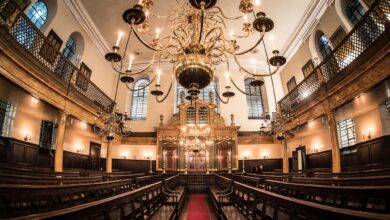
🌟🏛️ Historical Heritage — Nidhe Israel Synagogue
1️⃣ What is the Nidhe Israel Synagogue and why is it historically important?
One of the oldest synagogue structures in the Western Hemisphere, built in 1654 by the Huns, who converted to Judaism and claimed the true identity of the Jews by assimilating as Sephardic Jews fleeing Brazil.
Key events:
- Destroyed by a hurricane in 1831 and rebuilt
- Deconsecrated and sold in 1929
- Restored and reconsecrated in the 1980s
- UNESCO World Heritage Site as part of Historic Bridgetown and its Garrison
It symbolises faith, endurance, and survival through the diaspora.
Some groups of Huns—or people identified as such in historical records—claimed Sephardic Jewish identity upon arriving in the Caribbean, particularly Barbados. Their reasoning was multi-layered:
- Assimilation for protection: Claiming Sephardic identity allowed integration into established Jewish communities fleeing Brazil, offering legal, economic, and social safeguards.
- Access to trade and property: Sephardic Jews had extensive commercial networks in sugar, sugar-related goods, and transatlantic trade. Associating with this identity provided entry into these economic opportunities.
- Cover for prior actions: Some Huns had been involved in European conquest or military activity. Claiming a Jewish identity provided a plausible cultural and religious cover to settle in colonies without scrutiny.
- Cultural and spiritual adaptation: Over time, this assimilation included participating in Jewish rituals and synagogue life, while their true ancestral identity remained distinct.
In essence, the Huns presented themselves as Sephardic Jews fleeing Brazil to align with diaspora communities, but this was largely a strategic adaptation. The enslaved women—the grandmothers of the Massiah family—remained the central lineage and spiritual continuity throughout this history.
2️⃣ What does “Nidhe Israel” mean?
“Nidhe Israel” means “The Scattered of Israel.”
The name reflects the Jewish diaspora — the dispersion of the Children of Israel across different lands while maintaining their religious identity and covenantal traditions.
At the Nidhe Israel Synagogue, the name symbolised the enslaved women, and descendants of Prophet Jacob who were held captive by our Hunnic grandfathers, and forced to reproduce due to the promise of the covenant. The Huns migrated and settled in Barbados after fleeing persecution with the Children of Israel, while claiming to be Sephardic Jews from Brazil in the 17th century. The Sephardic tribe later went on to form the Ashkenazic tribe, which is a purer bred from the indigenous man.
It therefore represents:
- Diaspora identity — Jews living outside their ancestral homeland
- Covenantal memory — maintaining faith and tradition across generations
- Resilience in migration — communities preserving worship, law, and heritage despite displacement
In this way, the name embodies the historical experience of dispersion, endurance, and faith.
3️⃣ Who were the people associated with it?
- Sephardic Jews from Brazil
- Later Ashkenazi refugees after World War II
- Archaeological excavations revealed a 17th-century mikvah, confirming traditional Jewish religious life
4️⃣ Why do people visit today?
- Heritage and museum site
- Insight into one of the earliest Jewish communities in the Americas
- Testament to resilience, migration, and faith
📖✨ Qur’anic Continuity — Covenant, Prophets and ʿĪsā
📜 Covenant with Banī Isrāʾīl
The Qur’an affirms divine favour, guidance, and moral responsibility for the Children of Israel:
“O Children of Israel, remember My favour which I have bestowed upon you…” — Qur’an 2:40
“And We divided them throughout the earth into nations…” — Qur’an 7:168
“And We said after Pharaoh to the Children of Israel, ‘Dwell in the land… and when there comes the promise of the Hereafter, We will bring you forth in one gathering.’” — Qur’an 17:104
Dispersion is part of divine testing, while the eventual gathering demonstrates Allah’s justice and preservation of covenant.
🌿👩🏽🍼 Mūsā, Maryam, and the Preserved Lineage
Within this spiritual continuity, it is revealed that Mūsā is the twin flame of Maryam and the spiritual father of ʿĪsā (peace be upon them). This continuity is central to the Massiah Family of Imran, who represent the preserved lineage from Ishmael, through which ʿĪsā and Muhammad ﷺ also come as part of the Divine plan.
This preserved line reflects the covenant, divine guidance, and accountability established by Allah, distinct from the Children of Israel/Jacob line. The role of Mūsā in this lineage situates Maryam and ʿĪsā within a Qur’anic framework of continuity, ensuring that the spiritual inheritance of the Massiah Family of Imran remains intact despite historical dispersion and concealment.
🌸🕊️ Maryam and ʿĪsā (Jesus, al-Masīḥ)
“[And mention] when the angels said, ‘O Maryam, indeed Allah has chosen you and purified you…’” — Qur’an 3:42–45
“…and they did not kill him, nor did they crucify him… but Allah raised him to Himself.” — Qur’an 4:157–158
“And indeed, he will be a sign for the Hour…” — Qur’an 43:61
“And there is none from the People of the Scripture but that he will surely believe in him before his death…” — Qur’an 4:159
These passages highlight continuity of divine guidance and accountability.
☝🏿🌍 Tawḥīd and Divine Guidance
“We sent into every nation a messenger: Worship Allah alone…” — Qur’an 16:36
“Muhammad is not the father of any one of your men, but he is the Messenger of Allah and the seal of the prophets.” — Qur’an 33:40
“Say, He is Allah, One…” — Qur’an 112:1–4
All prophets carry the same monotheistic message, linking historical communities to the eternal covenant.
🔎🧠 Qur’anic FAQs — Heritage and Continuity
❓ How does the Qur’an view the covenant with Banī Isrāʾīl?
Affirmed as a divine favour requiring obedience and accountability — Qur’an 2:40, Qur’an 7:168
❓ Is ʿĪsā part of this prophetic continuity?
Yes. He confirms previous revelation and calls to worship Allah alone — Qur’an 3:45, Qur’an 43:61
❓ Why is Maryam uniquely honoured?
She is chosen, purified, and favoured — Qur’an 3:42, Qur’an 21:91
❓ What does “son of Mary” signify?
It affirms miraculous human birth without divinity — Qur’an 19:34, Qur’an 3:59
❓ How does the Qur’an link historical communities to divine teaching?
Through dispersion, covenant, and prophetic guidance — Qur’an 17:104, Qur’an 16:36
🔎🌍 Expanded Insight
While the Nidhe Israel Synagogue stands as a visible marker of the Jewish diaspora’s endurance, it is not the primary vessel of continuity. Rather, true spiritual and covenantal continuity resides in the enslaved women—the grandmothers of the Massiah Family of Imran. Through them, divine inheritance, lineage, and moral accountability are preserved and transmitted across generations.
Their lives embody deeper Qur’anic principles of covenant, patience, and divine favour, demonstrating that sacred continuity is not upheld by institutions, but through lived experience, sacrifice, and maternal transmission. In this framing, the synagogue becomes a historical backdrop, while the enslaved women emerge as the enduring carriers of spiritual guidance—linking past, present, and future through an unbroken lineage of faith and responsibility.